


McKinley builds prairie garden to enhance learning
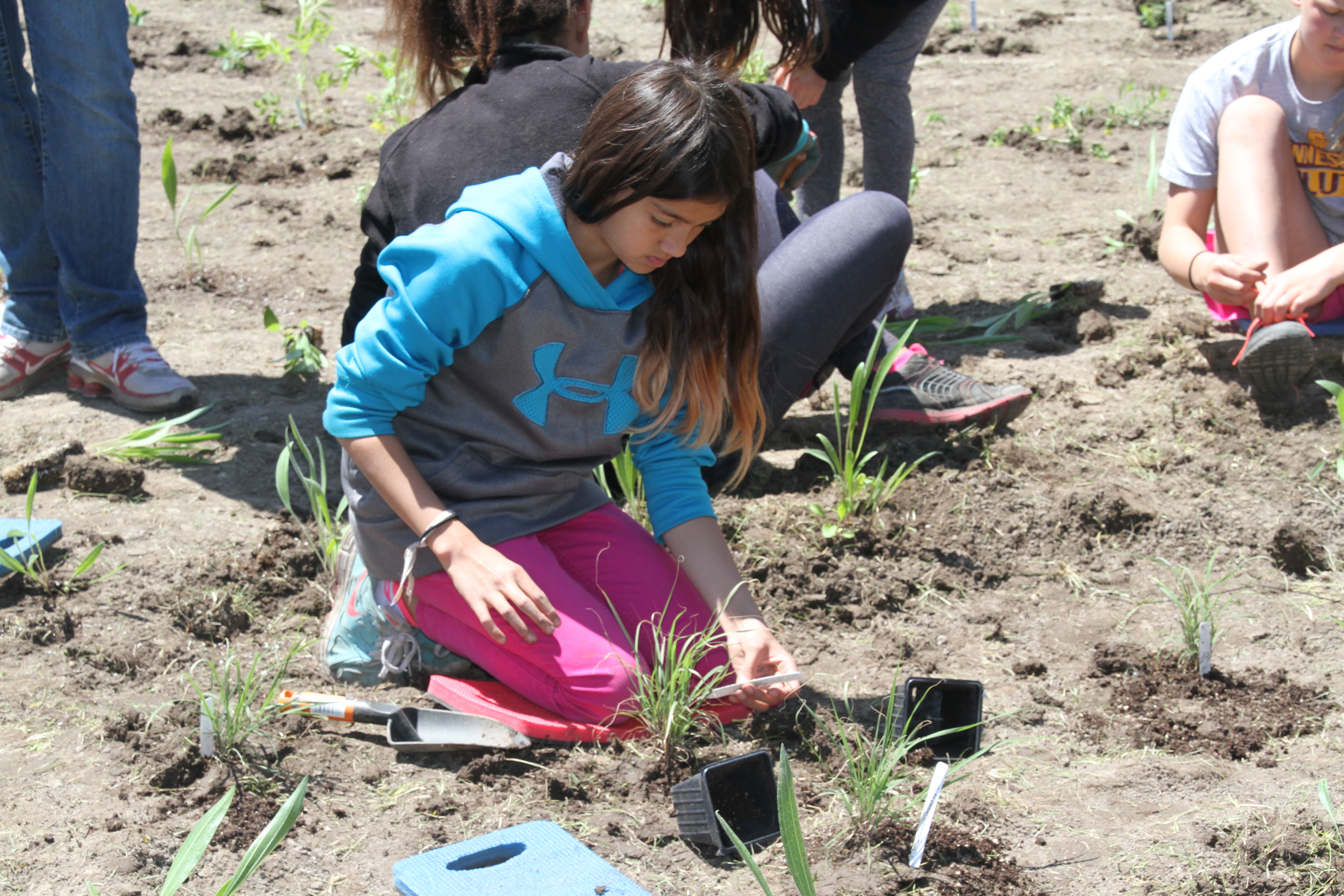
Students at McKinley Elementary School now have the opportunity to learn the curriculum in an outdoor classroom setting centered in the middle of a prairie garden that was designed and built by them.
This is McKinley’s third and final year receiving a grant from the PAINT initiative (Perpich Arts Integration Network of Teachers), which focuses on standards based in art integration.
“My vision at the beginning of this year’s project was to use the money in a way that our students’ art could be a permanent structure at our school to help create the experience of a STEM school,” said art teacher and Perpich team leader Amanda Gislason.
Gislason’s vision, along with District STEM Coordinator Tom Meagher’s vision of an outdoor classroom, paired together to create a 4,000 square feet prairie garden equipped with around 600 plants and 32 boulders in front of the building.
“The idea was not only do we use an outdoor garden to help teach, but it can also be used by everyone as a place to meet together, to learn, to share ideas and to really bring nature to campus instead of having to take kids off campus to view nature,” Meagher said.
The students began working on the project in March and have put in numerous hours since in creating, designing, planting and taking care of the garden.
Each grade level was responsible for a portion of the circular garden. During the project students explored many concepts such as native plants versus invasive species, different types of plants, the development stages of a plant, engineering, landscaping and how to maintain a design.
The first-graders’ portion of the project integrates science, language arts and visual art. After investigating children’s book writer and illustrator Eric Carle, the students chose a prairie animal to research and created painted papers to make a collage of their animal in its habitat.
Their artwork was placed on metal signs in the garden along with a QR code that can be scanned to read the students writing about the animal.
The second-graders’ portion of the project integrates science and visual arts. The students chose a native prairie plant to research its basic needs and planted it in the garden. Each student painted their plant on canvas in the style of artist Georgia O’Keeffe, and their artwork was also placed on signs along with a QR code in the garden.
The third-graders’ portion of the project integrated social studies, language arts and visual art.
Students studied sound in science, specifically pitch and vibration, and created instruments that could withstand Minnesota weather and be placed on the outer edges of the garden.
A sign with a QR code is attached to the instrument so viewers can see a video of the student explaining their instrument, how they made it and how it changes pitch.
The fourth-graders’ portion of the project integrated social studies, language arts and visual art. Students chose a state to research and created a map that includes major cities, rivers and landmarks, as well as a brochure. Students then painted their map on a stepping-stone to be placed in the garden.
The fifth-graders’ portion of the project integrated science, language arts and visual art. Students studied prairies and took several field trips to both natural and man-made prairies. Each student created their own landscape design, and students took a vote to determine which one they would implement. The winner was Olivia Shaw.
“To watch 50 kids out there working on landscape fabricing, mulching, planting, watering, preparing soil and watching fifth graders work with second graders… the whole experience was just absolutely stunning to watch,” Meagher said.
Gislason added, “My hope is that the project will be a learning environment for our students. A place and learning they feel proud of. I hope this project can make McKinley stand out as a STEM school in our district. I believe it showcases what we are all about, and I hope it encourages more kids to come to our school.”
McKinley staff hopes to be part of a smaller initiative next year that would focus on arts integration sustainability and be funded by the PAINT initiative, although to a lesser degree than previous years.
The initiative would require a group of teachers to come up with ways for the school to continue arts integration without the financial support of the PAINT initiative.