


The hunt for drunks
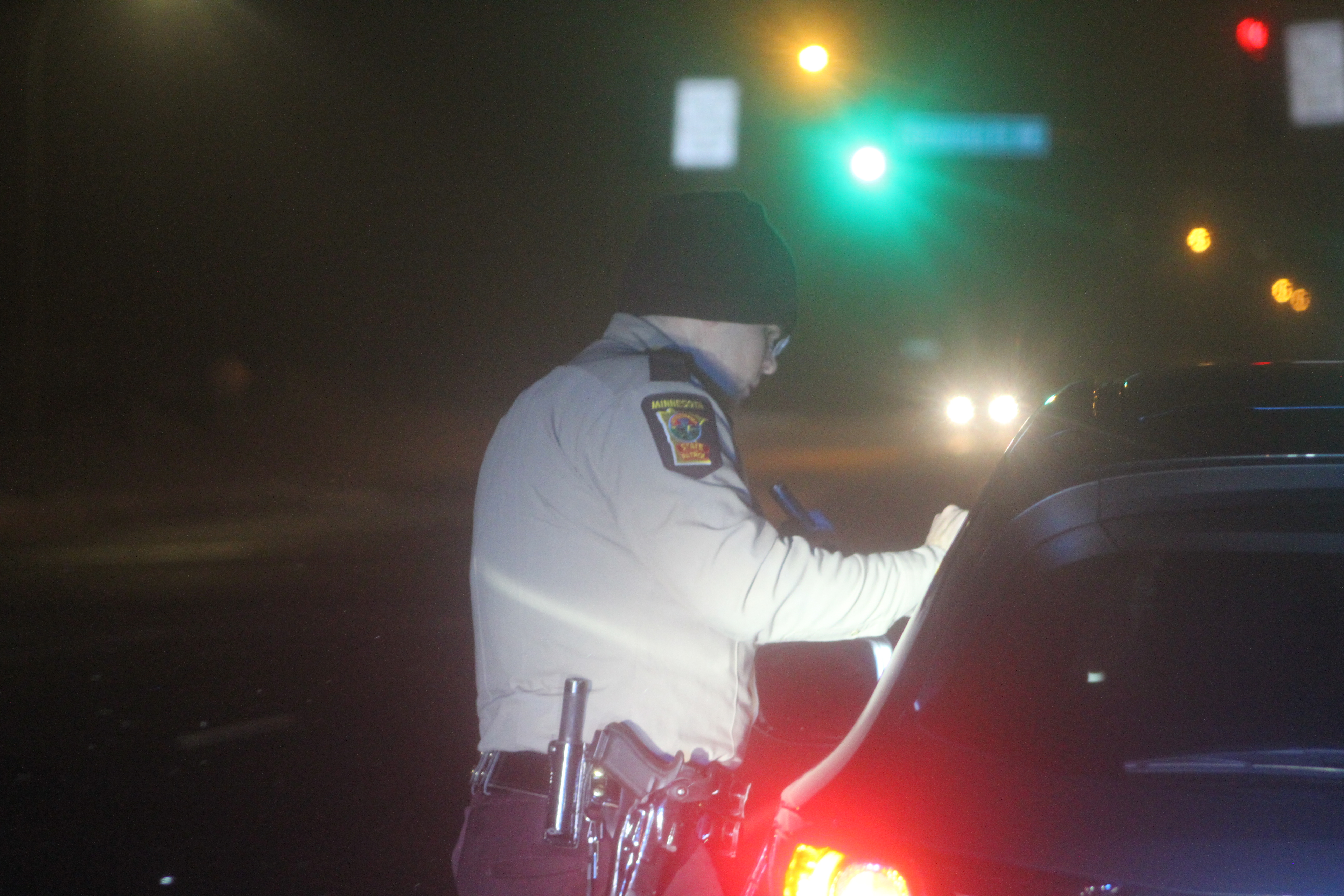
Every year the Minnesota State Patrol gives an award called the “Eagle Award” for the top DWI enforcer in the state.
In 2018, for the first time ever a trooper from the outstate, Mitch Elzen, won the award. Elzen, who lives in Dodge County, patrols southeastern Minnesota, mostly Dodge and Olmsted counties.
For Elzen, unfortunately, he and his family know what it’s like to have consequences from someone driving drunk.
In 1982, Elzen’s father, Ron, was looking at the damage from a small fender bender for less than a minute, when he was struck on his left side by a drunk driver.
After being tossed 180 feet down the road, Ron suffered internal bleeding in his stomach, a broken hip, broken back, and a crushed right ankle.
Since then, he has had many different surgeries.
Ron explained when he found out it was a drunk driver, he was upset.
“I was upset that he was on the road,” Ron said, in a video for the Minnesota Department of Public Safety.
“I became a state trooper to take drunks off the road, and to help other families,” Elzen said in the same video.
For Elzen’s dad, his success of getting drunks off the road makes him very proud mainly because he’s helping to save families from going through what his family and him have gone through.
“I’m proud of him,” Ron said in the video. “He’s getting these drunks off the road so no one has to go through what I and my wife have gone through,” he added.
Seeing what his dad has to go through because of a drunk driver fuels Elzen’s passion for being a top DWI enforcer.
“I’m very passionate about arresting drunk drivers or impaired drivers because I don’t want to see another innocent family go through what my dad, my mom and all of my siblings had to go through,” Elzen said.
The journey to State Patrol
While Elzen is considered one of the best DWI enforcers in the state, he explained that his journey of becoming a trooper wasn’t a conventional one.
After attending Mankato State for an education degree, he began a career as a physical education and health teacher.
Subsequently teaching for a year, he was offered to do a ride along with a State Patrol captain, who happened to be the father of some of the athletes that he coached.
After doing the ride along, Elzen knew from that moment on that he wanted to be a trooper.
“I fell in love with it,” Elzen said.
Ultimately, after the ride along, Elzen applied to be a trooper and was one of the few that got accepted from about 1,600 people.
Through a new program started by the state, he was able to go through schooling needed without getting a new four year degree, and in 2011 he began his career as a state trooper.
Since then, he has done something that many would agree with as being very important: he gets drunk drivers off the road.
The hunt for drunks
When it comes to enforcing DWIs, Elzen explained that you need to be motivated to do it night after night.
For Elzen, he goes out during every shift with the mentality of getting a drunk off the road.
“Every night, I hunt for a drunk,” Elzen said.
While there are some nights every so often when he doesn’t have any DWI arrests, there are also sometimes when he has “hat trick” nights.
This is a term used when an officer makes three DWI arrests in one night.
For Elzen so far in his young career he has had five hat tricks in his career.
Elzen explained that finding and taking drunks off the road takes a lot of skill.
“It’s definitely a skill,” Elzen said.
Aside from having the skills of being able to identify signs of possible impairment, Elzen explained that it is also important to be where drunk drivers are at the right time.
A perfect example of this came recently when he was taking a drunk driver to jail when a motorist was driving in the wrong way right towards him.
He then pulled the vehicle over and was able to make another DWI arrest and took both of them to jail.
“It’s all about being in the right place at the right time,” Elzen said.
Patience
Elzen explained that one of the things that is required in order to get drunks off the road night after night, is a lot of patience.
“When you’re hunting for drunks, it takes a lot of patience,” Elzen said.
That patience was exemplified during his most recent shift.
After a slow night, Elzen stopped a vehicle for speeding.
After detecting the smell of alcohol on the woman’s breath, Elzen had her go through a series of field sobriety tests.
After the standard tests were performed, she completed the final test, which was the portable breathalyzer test. She was under the legal limit and allowed to continue home.
Then around 1:45 in the morning, on a main street in Rochester, Elzen noticed a vehicle almost go the wrong way on a one way street and continued to fail to stop at a red light.
Elzen activated his emergency lights and made contact with the driver.
After speaking with the driver, he quickly noticed that the driver was trying to hide her paper ID.
After observing signs of intoxication, Elzen had the driver perform field sobriety tests and asked the driver to submit to a PBT.
She denied to do this and was placed under arrest.
The two passengers in the vehicle walked home, and the vehicle, which was owned by one of the passengers, was parked in a nearby parking lot.
The driver was brought to the station where she was read her rights and the Minnesota Implied Consent Advisory, which means that drivers have to submit to a breathalyzer test if suspected of being under the influence.
As part of this, drivers always have a “reasonable” amount of time to contact a lawyer and a phone and phone book are provided.
After consulting with a lawyer, the driver refused to take the test, which is a crime in of itself.
For the driver, that means the state will revoke her license for two years because of a previous conviction. She was also charged with third-degree DWI-failing to submit to a chemical test, which is a gross misdemeanor. She was also charged with driving after revocation, which is also a gross misdemeanor.
On top of this, because of the previous conviction and new charges, the license plates on the vehicle she was driving were also seized, even though it wasn’t her vehicle.
This means that the owner of the vehicle will have 45 days to get new plates.
After the arrest, and on the way back to the car to seize the plates off the car, Elzen explained that he was satisfied about taking another drunk off the road.
“Who knows what could have happened if I didn’t,” he said.
With the arrest made by Elzen he brought his total for the year to 146 DWI arrests.
For Elzen, getting drunks off the road is extremely important and he hopes to continue to do so at a high level for many years to come.