


Bringing home the bacon
Americans have a seemingly insatiable hunger for bacon.
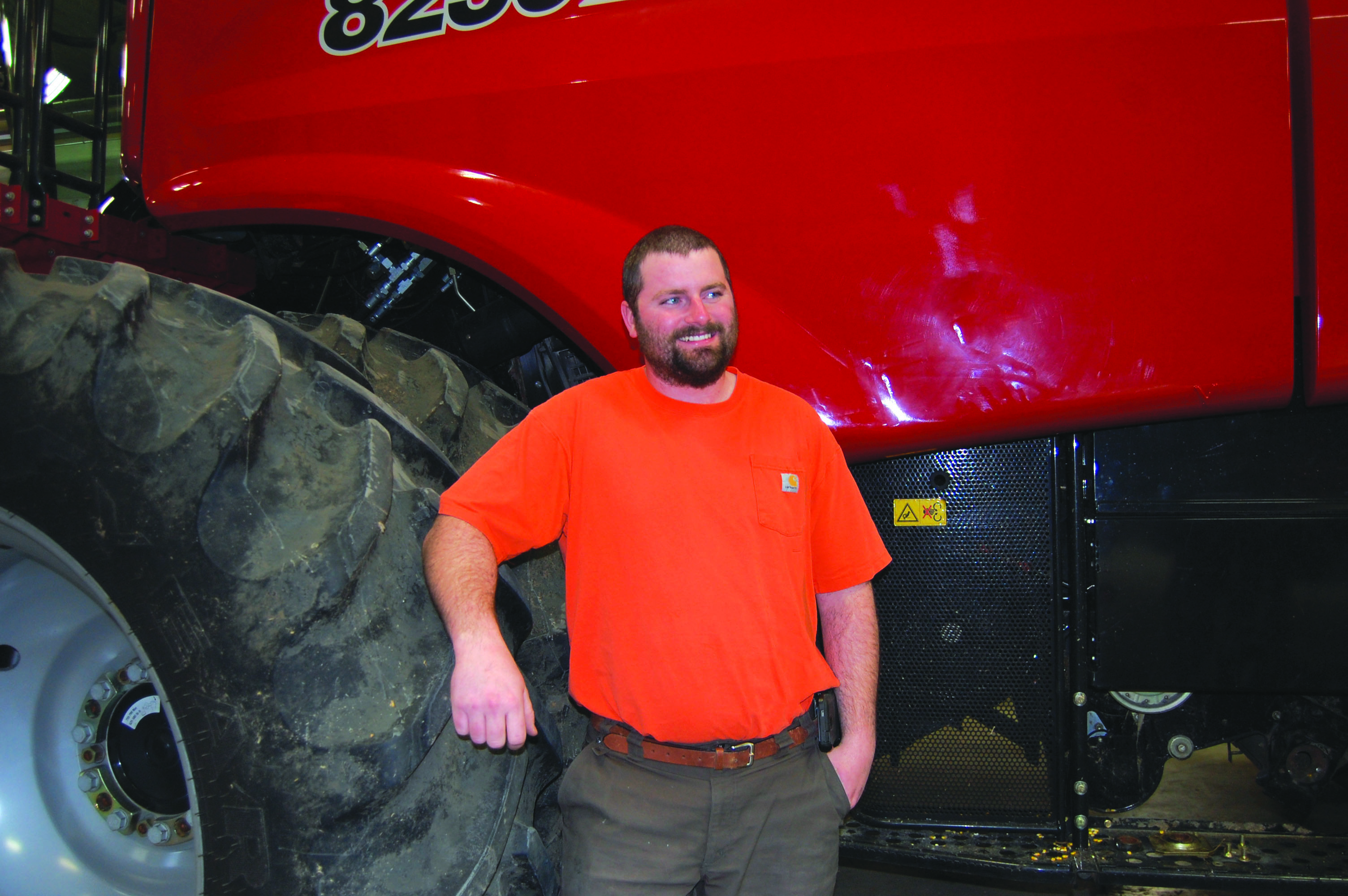
Pat O’Connor, who farms with his family just outside of Blooming Prairie, is one of a number of Steele and Dodge County farmers who are trying to satisfy that hunger.
Along with their other farming endeavors, the O’Connors raise hogs. Lots of hogs. One location has two barns, each holding 2,400 head of hogs, while Pat O’Connor also has one barn on another location, this one also containing 2,400 head of hogs. He farms with his father, Jim O’Connor, and his brother-in-law, Sam Wencl.
And whether it’s growing crops or raising pigs, it’s definitely not your grandfather’s farm.
O’Connor said there are three levels of feedlots for raising hogs and his family is operating at the finishing barn level. They get the pigs at about 55 pounds and raise them to their market weight of about 280 pounds.
O’Conner explained that he does not own the pigs that are in his barn. Rather, he is raising them for another farmer, in this case a farmer in the New Richland area. The piglets are born at one location where they stay until they reach about 10 pounds. At 10 pounds they are weaned and transported to a second farm where they are raised until they reach the 55 pound level and move on to the finishing barn.
When they reach that target weight they are transported by truck to the packer. The end market can be any one of several well-known names, including Hormel, Tyson or Smithfield.
O’Connor contracts with the original owner to bring the pigs to market weight.
“This is pretty much the standard in the industry,” O’Connor said. “2,400 head is the norm (for the finishing barn), A lot of nurseries it is 5,000.”
O’Connor said he contracts with the owner of the pigs to raise them at a set rate per pig.
The animals’ owner provides the pigs, the feed and the medications they need. O’Connor said he provides the barn, maintenance, mechanical and electrical, fuel and labor.
Most hog farmers will have several barns, he said, as marketing the hogs every four months is what makes the operation financially feasible.
It allows a young farmer like himself to get started in the business because there will be income generated in a matter of months, he said.
O’Connor’s pigs are housed in large barns where virtually everything is automated, he said. Temperature probes in the barns keep the temperature maintained at 65.9 degrees. The pigs have continuous access to food and water 24 hours a day which is automatically delivered to each pen, he said.
Each pen, he added, contains 30 pigs.
The operation is not, however, without human intervention, O’Connor said. Each day they physically walk through the barns twice a day. He said they go into each pen and check out each individual pig to make sure they are healthy. If any are found to be sick, he said, they are treated, generally with penicillin.
The process of entering the area containing the pigs is not simple either, he said. On entry to the barns, he explained, is the area where the farmer can check temperature level in the barn, water and feed usage. There is also a large viewing window that allows him to get an over view of the pens.
For health reasons, he said, it is necessary to change into separate clothing to enter the actual barn. This, he said, is to prevent the spread of disease to the pigs. In 2013 and 2014 Porcine Epidemic Diarrhea (PED) spread throughout the Midwest and resulted in losses of animals throughout the area.
“PED was a very bad virus,” O’Connor said. “It could wipe out a barn in a couple days.”
Strict safety measures on entering or leaving a barn, along with research on the virus, has gotten a good handle on the virus, he said. In addition to being a safe environment for the pigs, O’Connor said, the facility is also safe for the environment.
More than 2,000 pigs in a barn will generate a considerable amount of manure and O’Connor explained that the waste from the animals in his barn goes into a concrete pit underneath the barn. The pit is eight feet deep, he said, with an eight inch wall and is reinforced with rebar. The pit is surrounded by an inspection tube with an inspection port enabling him to see if there are any leaks in the pit.
The pit is drained every year, he said. The O’Connor’s spread the liquid organic fertilizer on their own fields, he said, a process that takes about two days.
He said they “knife” the fertilizer directly into the ground and it does not get into the groundwater.
O’Connor said his family also is involved in crop farming raising corn and soybeans. The family has its own feed mill where they can grind corn and soybeans and also sell corn to Interstate Mills in Hayfield.
There is a reason that so many feedlots have been built in southern Minnesota and the surrounding area.
Livestock eat corn and soybeans, he said.
“The upper Midwest is where the corn is grown,” he said. “They (the livestock) need corn and soybean meal.”
“Without livestock these by-products would have to be shipped elsewhere,” he said.
O’Connor said he does everything he can to make his operation more efficient.
He said he meters his water usage so he knows it down to the amount each pig consumes.
“I’m doing absolutely everything I can to reduce fuel and energy costs,” he said.
O’Connor said his family has been farming in the area since 1858 when the “home place” in Dodge County was settled. He grew up in the area, he said, graduating from Blooming Prairie High School where he was active in FFA.