


Airport houses grounded aircraft
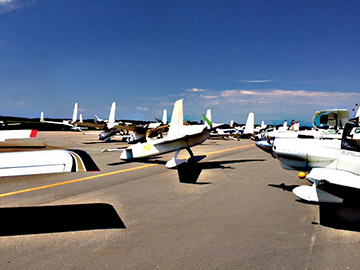
If you were to drive north on I-35 on any given day, the chances that you would see hundreds of aircraft grounded at Owatonna Denger Regional Airport should be pretty slim. However, that was not the case this past Sunday.
As a midway check point in the Air Venture 2016 race, the airport was supposed to act as a refueling station for those whose planes didn’t have the range to complete the 216 nautical mile jaunt from Mitchell, S.D. to Oshkosh, Wis. Dave Beaver, the manager at the airport said the event draws thousands of planes not just from around the country but even the globe.
The airplanes were a part of the EAA Airshow, which Beaver said that everyone who was a part of the venture was required to fly into or over the checkpoint at the airport that way officials for the race could get a time for the leaderboards at the halfway point. He said that the race started at 9 o’clock in Mitchell, which would have given the pilots about an hour or so flight before reaching the refueling station. Beaver said that they were expecting roughly 20 aircraft that would have to land to be refueled before they completed the trek and started to see the first group of aircraft approach the runway. However, with inclement weather currently in the path of the second part of the race, Beaver said that by 10-11 a.m., they were seeing a fleet of aircraft approach for landing. So rather than expecting to assist and direct 20 pilots, they were now on the cusp of doing both for roughly 100 aircraft that had to land due to inclement weather between the checkpoint in Owatonna and the finish line in Oshkosh.
Beaver said that the 85 participants that were grounded also had to mesh with the planes that are currently held at the general airfield. While the number jumped drastically, he mentioned that under the circumstances it was actually something that anyone who has an affinity for aircraft would have enjoyed. “It was a variety of airplanes. Some homebuilt, experimental type airplanes, there were some turbine jets, twin engines... There were all kinds of airplanes.”
With the sudden spike of numbers, Beaver and his staff operated under what he said there are federal protocols that are well establish all throughout the country that followed. Beaver said they had some extra staff on hand for the event, to include race official from EAA. He also mentioned that to assist the extra staff and the race officials on hand that there were a handful of volunteers that were there to provide assistance also. Beaver said that while adhering to the federal guidelines, the primary objective was to have a safe operation for both the airport and the people within the premises.
They had to set up a fueling operation, designed a designated holding pattern to park the pilots while they were to wait out the storm and still had to assist with their normal traffic which Beaver said is higher than any other part of the year.
“We assigned people to fueling stations, setting up to line and how that would flow. We also had flag people to assist with parking.”
He said that the biggest area would have a problem is when pilots are being directed off the runway.
“If the pilots aren’t directed on how to park, it can become disorganized.”
The communication in the parking aspect of the operation was key. Beaver mentioned that the adjustments made for parking allowed them to accommodate for some of the larger aircraft that were partaking in the 19th running of the race.
Despite the at times overwhelming amount of aircraft, Beaver said that the operation went fairly smooth.