


Robots revolutionize milking cows
Cows milking themselves?
That might be a little bit of a stretch, but not far off at the Balzer Dairy Farm east of Medford.
Rick Balzer and his son, Scott, have been milking with the assistance of robots for almost 10 years. What once took lots of physical labor twice a day has now been replaced with robots milking the cows pretty much anytime of the day or night. They are the only dairy operation in Steele County that utilizes robotic technology. There are a couple others in Rice County and one in Waseca County.
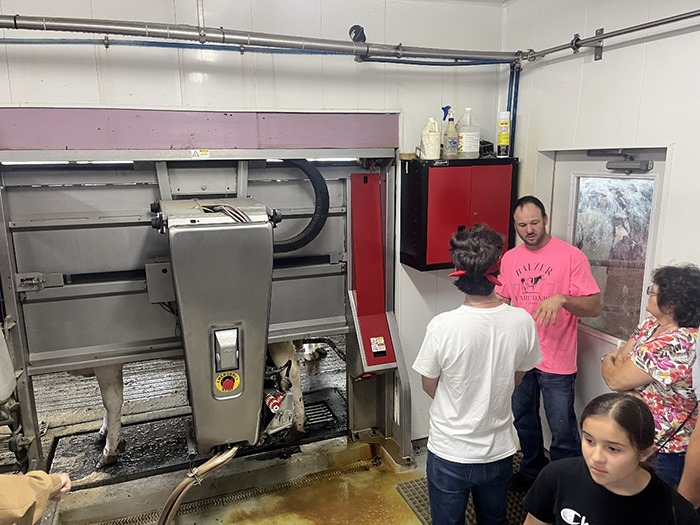
On Saturday as part of Breakfast on the Farm, the Balzers opened their dairy barn to guests to see how the robots have replaced humans.
The cows are milked 24/7 or when nature calls for them to unload their milk. At their own pace, the Holsteins at the Balzer farm stumble into the robot stall whenever they feel like it. It’s their choice when they get milked.
The 110 cows average three milkings a day, according to Scott. Each one produces about 80 pounds of milk, or roughly 9 gallons. That’s 8,800 pounds of milk per day or 3.2 million pounds per year shipped to First District in Litchfield, Minn.
“We get more efficiency with the robotic milkers,” Scott says.
Once they get into the stall, a transponder around the cow’s neck identifies it and transmits information to a computer. Sensors record all the important data about the cow’s health and milk production.
A brush washes and stimulates the cow’s teats twice prior to milking. It takes just six minutes to milk a cow. Once the milking is done, the cups detach, and the robot cleans the teats once again before applying iodine dip to protect open teat canals from infection. The cow is the released and free to access her feed and bedding until she is ready to return for another round of milking.
While milking began at the Balzers in 1949, the robots have been engrained into the operation since 2015. In fact, the Balzers built the dairy barn in 2015 designed around the robots, which were made in Pella, Iowa.
Rick Balzer said he made the decision to add the robots once Scott committed to coming back to the farm after being away at college.
When something goes awry, Scott gets an alert on his smartphone letting him know. The robots automatically shut down for certain alarms.
Scott says the greatest advantage of robotic milkers is the flexibility it provides. The amount of labor to run the dairy operation is greatly reduced, allowing producers like the Balzers to devote more time to other important tasks around the farm.
“We can be doing field work, eating meals and enjoying holidays,” Scott said. “We don’t have to worry about getting back here to milk. It’s nice to go home and eat or sleep, and the cows are always being milked.”
Scott was in his element Saturday as he shared his knowledge with others about dairy and how the robots have revolutionized their operation. “It’s fun to see people’s reaction to the robots,” he said.
“This is so interesting,” one woman said as she listened to Scott’s presentation.
Most importantly, he said people need to understand where their food, which in this case dairy products, is coming from. “It’s not just coming off the shelves at Walmart,” Scott said.
There’s no pushing or prodding to get the Balzer cows milked. They go in hot pursuit of milking themselves with, of course, the help of robots.