


Ramona Bigelow recalls trip to Scandinavia
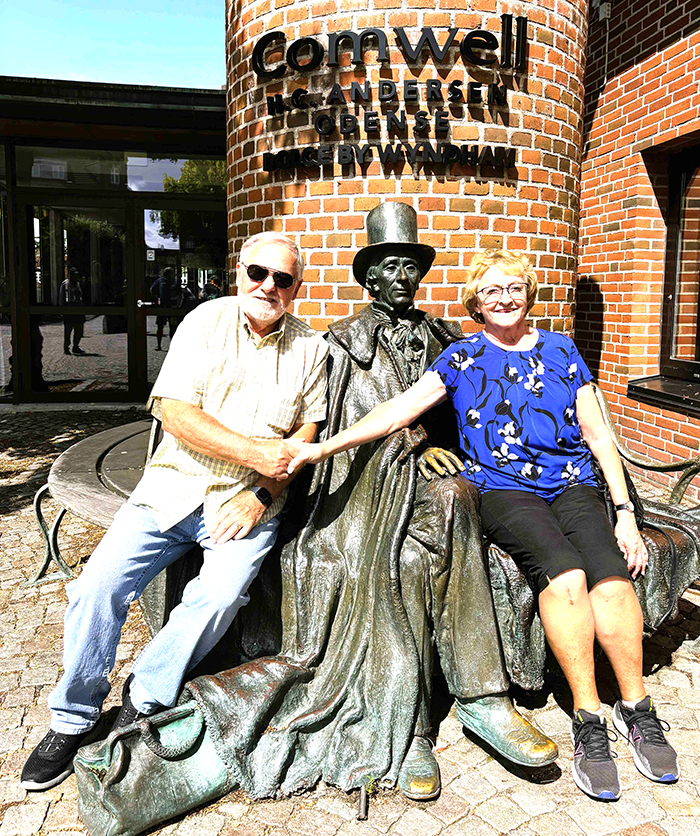
(Editor’s Note: Bruce and Ramona Bigelow went on a trip to the Scandinavian countries this summer. This is an account of the Denmark portion of the trip.)
This is the story of our incredible trip to Denmark, Norway and Sweden with a Trafalgar tour. We left Minneapolis, and our first stop was Reykjavik, Iceland. Then we went on to Copenhagen where we met some fellow travelers in the airport. We were absolutely exhausted by the time we got to our room.
We took an orientation drive on the bus through the city of Copenhagen. It was raining hard, so umbrellas were necessary. We were cautioned before getting off the bus that there are 14 million bicycles in Denmark, most of them in Copenhagen! The bicycles have their own lane, and you don’t want to step out into that lane without looking both directions!
Cars are extremely expensive, and most people do not own a car. Thus, the reason for so many bikes.
We stopped near the Town Hall Square, and walked along the Nyhavn Harbour. Copenhagen means Merchants Harbor. Along the harbor are brightly colored buildings hosting restaurants, bars and shops. Despite the rain, there were big crowds of people — walking, dining, drinking and shopping. We were told the average Copenhagen resident drinks liters of beer every day! The population of Copenhagen is 1.6 million.
There were 43 guests on our trip. Our group was diverse, from many parts of the world, and we developed some friendships with many.
The next morning, we were still very tired from the time change but ready to tour. We had a local specialist (Ida) who gave us a fascinating sightseeing tour of Copenhagen and the island. We saw the Amalienborg Palace Quarter, built during the reign of Frederik V.
A few of the highlights were: The Little Mermaid located in the Port of Copenhagen. This statue represents the principal character in Hans Christian Andersen’s tale of the little mermaid. It was erected in 1913. Vandals have decapitated the Little Mermaid on several occasions.
Next, the Citadel in the historic Holmen naval base. This was built in 1666 to defend the entrance of the port of Copenhagen. It has now been turned into a massive park. The English Church of Saint Albans is a beautiful marble Lutheran church. Denmark is 90% Lutheran although not many people attend church. It is said people go to church three times in their life — when they are hatched, when they are matched, and when they are dispatched!
The pompous Gefion Fountain is located near the Citadel. This fountain represents the Nordic goddess Gefion who, according to the myth, turned her four sons into oxen. She used them to pull off a piece of Swedish land which she then threw into the sea, creating the island of Zealand.
We heard the story of Hans Christian Andersen. Ramona brought along a piano book which I have had for years picturing Danny Kaye from Samuel Goldwyn’s production of Hans Christian Andersen! He was born to poor parents and at the age of 14 went to Copenhagen to try and realize his dream of a career in theater. He tried to be a ballet dancer, an actor and a singer, but succeeded in becoming a playwright. His childhood home is located in Odense. He never married and was said to have led a lonely life.
Our local tour guide showed us the crown jewels guarded in Rosenborg Castle and we walked through the Latin Quarter to see the Round Tower and the Copenhagen Cathedral. The University of Copenhagen was established in the 1700’s in the Latin Quarter. Also located in Copenhagen are the Tivoli Gardens which are 117 years old, and the oldest amusement park in the world. It opened in 1843. There are 44 gardeners who care for the Tivoli Gardens. At night 100,000 light bulbs illuminate the night sky.
We had a short break at the hotel before going on an excursion with the same local guide to the North Zealand Riviera and Castle Tour. Denmark is located on the Baltic Sea and is the world’s oldest monarchy. The sea divides Denmark and Sweden by 14 miles. We stopped by the Sea and our guide said “it is showing its teeth” which means the waves were really active.
Denmark has been voted to have the happiest people in the world. The people pay 75% to taxes, but the government does everything for them.
Inflation is 1%. Women get a year of maternity leave with full pay, men get eight weeks of paternity leave. Citizens get six weeks of paid vacation a year. Denmark has socialized medicine. A very alarming fact for Ramona was if you have breast cancer, you will wait for six months for surgery, and another six months for chemotherapy!
The flag of Denmark goes back to the 1100’s. They do not have nuclear power, only natural gas. It takes 14 years to get a rental apartment. You are on a waiting list, and you have to pay to be on the list! Denmark is a flat country; farming is mostly grains. Wheat is the biggest grain crop. Cows are located on the West coast. An average Dane drinks 1 quart of milk a day.
The climate facts: in winter they have four months of darkness; very little sun so skin cancer is not an issue; hardly any snow; average temps in the winter are 30 degrees in day, 27 at night. There are very few jails, and the inmates go home on the weekend! They love and trust their politicians. Everyone knows how to swim since it is taught starting in first grade. The Danes think how you talk to God is nobody’s business!
Lego toys were invented in Denmark. Le means play, Go means good. It was invented by a policeman while in a Nazi prison. He started with wood pieces. Our guide told us the story of the war. The Jewish people have been in Denmark since the 1600’s. In 1943 on October 1st and 2nd, Hitler wanted to round up all the Jews. The Danes protected the Jews, took them to summer houses and fishing villages, sailed into oceans with hidden Jews. Of 5,000 known Jews, 472 were caught. They were also protected in Sweden for 2-1/2 years. The Danish people kept the Jewish homes and possessions safe.
Many homes have thatched roofs. They are composed of reeds and covered with soil. A good thatched roof can last 50 years. Once the moss starts, the roof will leak. It costs approximately $20,000 to put on a new roof. They cannot change from thatched to shingles. There are no artificial Christmas trees in Denmark, only real ones. They put candles on the trees and they burn for five days. You are not allowed to cut down any trees on your property in Denmark. If you do, you get a fine of $10,000. The government gives approval for cutting down Christmas trees.
Next stop was The Royal Palace of Fredensborg, also known as Castle of Peace. It was established in 1722. It was not built with an eye to defense but a palace open to the public. It was the home of Crown Prince Frederik and Crown Princess Mary. (Now King Frederik X and Queen Mary.) This couple are extremely popular and loved by the Danish people. We had a delicious hot dog in a small caf? on the castle grounds. The hot dogs and pastries in Denmark are absolutely scrumptious! We were able to view the changing of the guard at the Palace which was rich with pageantry.
Our final stop with our guide was the Frederiksborg Castle which was completed in 1625 by King Christian IV. The interior was devastated by fire but later restored and opened in 1878 as a museum of national history. There are few words to describe this spectacular castle with its thousands of paintings illustrating outstanding events and personalities over the last 400 years of the history of Denmark. It has three wings — the King’s wing is in the center, the Chapel Wing on the left, and the Princess Wing on the right. The Chapel is stunning in its beauty with floor to ceiling paintings of Christ. The organ is massive, and the organist was practicing for a wedding to be held the next day.
A very interesting fact told to us by our guide concerned the small beds. She said the royal family didn’t believe in lying down flat on the bed. They slept sitting up. It was thought if one slept lying down you wouldn’t wake up the next morning. They tied children to the headboard to ensure they would sleep sitting up. This sure seemed cruel to us!
We went on to the Green Hills Mountain, also called Copen Hill, a modern project with a power plant inside for recycling. Denmark has the cleanest waste management system in the world. They have 12 bins for recycling and garbage! How does anyone know which bin is correct! We had planned to take the elevator to the top which has the best views of the city. Unfortunately, the elevator and restaurant/bar were closed for a private event. The stairs were 100 meters to the top, and approximately 500-600 steps. Most of us set out to climb to the top but only a few actually made it. Bruce was one of the few! I made it to 60 meters, but my knees wouldn’t let me go higher. The trip down was not an easy one either. There is a ski slope to the side of the mountain, and a climbing wall on the side of the building. We all developed a big appetite for the evening’s meal.
The evening was spent in the fairy-tale village of Dragor. This settlement has existed since the Middle Ages. Most houses are tiny with thatched roofs, standing shoulder to shoulder, and the narrow cobbled streets follow an unusual, rather haphazard pattern. There are hollyhocks everywhere! They also have peeping mirrors on their homes which allow one to see both sides of the street.
At the evening dinner we were seated across from a younger couple — Nils and Jeannette — who were from Ft. Worth Texas. They asked where we were from, and to our amazement, Nils said he went to school in Rochester. Bruce asked him which school and we couldn’t believe he said Churchill! This is where Bruce taught and was the principal.
Nils remembered Bruce and even called him Mr. Bigelow! He remembered going on the ski trips, the campouts at Forestville, and many other memories. It was fun to hear them talk about the old days in Rochester. We became very close to this couple and spent a lot of time with them. Our breakfasts always featured a wide variety of foods. Our tour guide kept telling us: “you’re on holiday….don’t worry about dieting!”
We left Copenhagen and went to Hekla Park, also called Amager Faelled, a nature reserve the size of 640 football fields. They are fighting the construction of homes and apartments infringing on this preserve. We walked about a mile on the trails, saw native grasses and trees, many with berries, listened to the birds, and enjoyed being in the park which was close to the bustling city.
It was a relatively short bus ride to Odense, the birthplace of Hans Christian Andersen. It was difficult to find a souvenir from Denmark, and we didn’t have enough time to go to the Christmas shop. In the afternoon we traveled to Randers. We walked downtown, usually a very quiet village, but they were having Oktoberfest in August!! We ate at a busy restaurant where we couldn’t understand the menu, got some help from a waiter, and gambled that we’d get something edible! It was good and the beer was even better! We went back to the hotel and underneath the hotel there was a band playing. We sat and had some wine and listened to the music. Every other song was in English, so we enjoyed that. It was our last night in Denmark.
(We will continue with their visits to Norway and Sweden next week.)