


Interim DC ambulance director reflects on challenges, hopes for future success
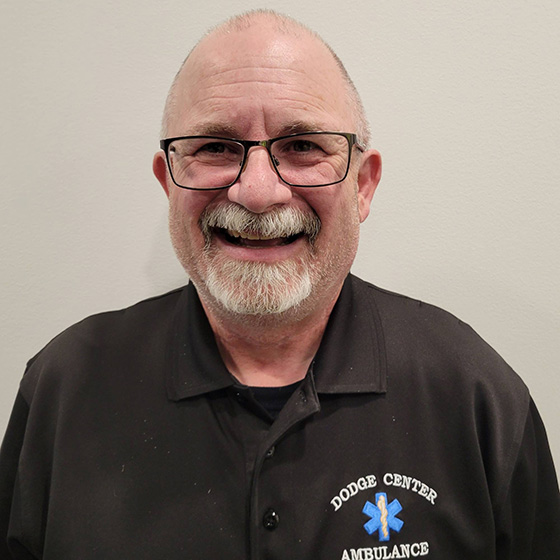
John Fox has done a lot over his close to three decades career saving lives.
Now, at the end of his career, the newly appointed interim Dodge Center Ambulance Director has just one goal; keep the ambulance going now and into the future.
“I’m not looking to go anywhere, I would love to finish out my career here. I think this is a fine community. I think this is a perfect example of how it can be done,” Fox said.
Due to funding and expenses, the Dodge Center Ambulance and the cities it serves including Dodge Center, Kasson, Mantorville, Claremont and several surrounding townships, have looked at potential funding mechanisms, including a potential taxing district.
Negotiations broke down towards the end of 2024, but Fox said the expectation is discussions will begin to take place again in the coming weeks.
Served country, then community
Fox was in the military in the 1980s, and went through a combat lifesaver course, which earned him a first responder certificate in North Carolina.
After leaving the service, Fox worked a number of jobs, including making eye glasses, before someone offered him the chance to become an EMT.
In 1994, he became certified and hasn’t looked back.
While working as an EMT at Mystic Lake Casino, he went to paramedic school, and eventually went to work for what is now called Lakes region EMS for 17 years, working in a number of different positions.
From there, he would take a director job in Wabasha, then worked in Cannon Falls, before being hired in Dodge Center.
Medicare, Medicaid Not New Problem
One of the major issues most officials point to when it comes to ambulance funding is Medicare and Medicaid reimbursement rates.
It’s something Fox first learned about in the early 2000s while part of the leadership team with Lakes Region EMS.
He explained a policy came out making it so if an ambulance accepted Medicare or Medicaid it could “balance bill the remaining cost back to the patient.”
Essentially before, Medicare and Medicaid would pay a certain amount, less than the actual cost to the ambulance, and the ambulance provider could make up the difference by billing the patient.
“Either you take Medicare and you do take what we give you or you can’t take Medicare at all,” Fox said about the new policy.
Fox and others knew it would change how ambulances operate, but at the time, the amount of patients on Medicare and Medicaid was less than it is now.
In rural areas like Dodge County generally 60 to 70% of patients are on some type of government insurance.
“As a whole those governmental payers will give you what they give you period,” Fox said.
Fox explained there has been a push to get Medicare and Medicaid to pay the true costs, but even if it happens, it may still not be enough to break even.
In order for an ambulance to “really do OK” the ambulance needs to be close to 2,000 runs a year, while Dodge Center does upwards of 1,200 a year.
“Even if they raise the rates to what we think it should be, we don’t have enough volume still to make up that difference,” Fox said.
Another battle local ambulances are facing is the fact ambulances aren’t paid for anything unless it transports a patient.
Fox said if there was a way for ambulances to get paid for the services it provides, it would help in a number of ways.
“We could save the system an incredible amount of money,” Fox said.
Hidden revenue
Fox explained for years, Dodge Center Ambulance and others in Greater Minnesota have survived due to volunteers in the community.
“We have been hiding our funding,” Fox said. “The biggest, biggest source of funding most rural ambulances get is volunteer labor.”
About a decade ago, it would cost an ambulance between $500,000 and $600,000 a year to staff an ambulance 24/7.
Now the cost is upwards of a million dollars a year. To replace volunteers it would cost $35 to $37 an hour, Fox said.
Last year, the department received about 14,000 in volunteer hours.
“That alone is the only reason we’re surviving,” Fox said.
Fox also recognizes the reality, each year the state has been losing more providers than it is bringing in, and the vast majority leaving are under 30.
“You can’t sustain a profession if you can’t bring young people into it,” Fox said.
Fox knows the future will depend on being able to move away from a mostly volunteer model.
“We can’t continue to rely on the goodness of volunteers to continue to make that happen,” Fox said.
The future
No matter what happens in the coming months with conversations taking place with local officials regarding Dodge Center Ambulance, Fox said one thing is for certain, there will be an ambulance for the community.
“We will have ambulance service for the community in whatever fashion that’s going to be,” Fox said.
He said the ambulance will still be available, “it’s just who’s going to have the say In how’s that done.”
With three of the communities in the Primary Service Area having new mayors, and other shakeups on the city councils, Fox said conversations will back up soon about what the future will look like.
“We’re still very interested in having conversations,” Fox said.
For Fox, the mission is showing people their model can work. His reward would be being able to retire from Dodge Center.
“I want to prove it can be done and done well and that the community can drive that,” Fox said.